Nobody wanted this job. That much was clear from the start. Word had gotten around the hospital staff quickly — the position involved round-the-clock care for a man who hadn’t opened his eyes in over two years, a man whose own doctors had quietly stopped expecting anything from him. The duties were physically demanding, emotionally draining, and deeply intimate in ways that made most candidates turn the offer down before the interview was even finished.
But Maya didn’t have the luxury of saying no.
Her mother had passed away after a long illness, leaving behind a mountain of medical debt that seemed to grow larger every time Maya opened her mailbox. On top of that, she was the only one supporting her younger brother through college. She was twenty-six years old, exhausted before her day had even begun, and carrying weight that would have broken someone twice her age. When the hospital administrator slid the salary figure across the desk toward her, she looked at it for a long moment and thought: I have no choice.
She signed the paperwork that same afternoon.
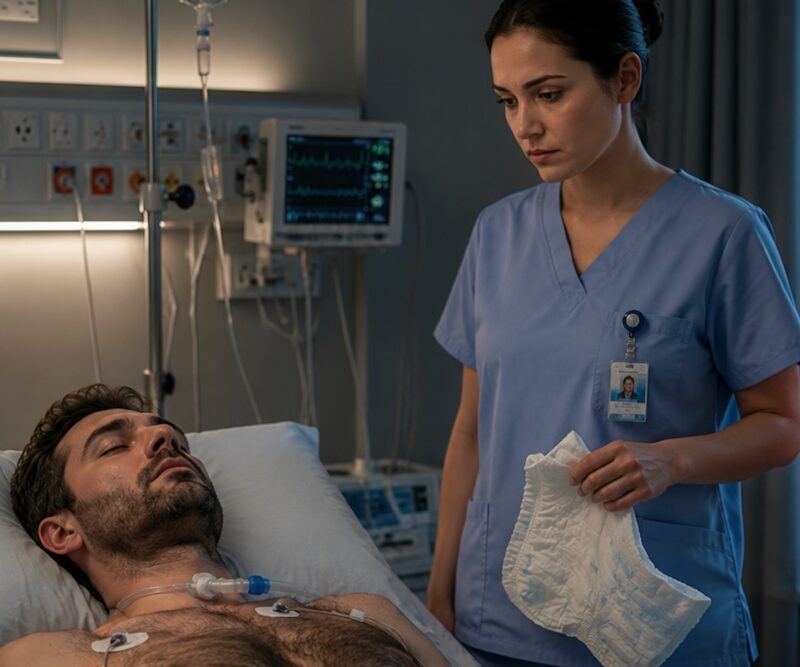
The room itself surprised her on that first morning. She had expected something sterile and cold — the kind of stark, fluorescent-lit ward that smelled of antiseptic and resignation. Instead, she walked into something that looked almost like a suite in a five-star hotel. Polished hardwood floors. Heavy curtains drawn to soften the light. Expensive furniture positioned around a hospital bed that held all the latest monitoring equipment money could buy. A security guard stood just outside the door, stationed there around the clock as though the unconscious man inside still had enemies worth worrying about.
The patient himself was motionless. He had been a real estate millionaire before the accident, powerful and sharp-minded by every account. Now he lay with his eyes closed, chest rising and falling only because the machines insisted upon it. The medical file was thick, but the conclusion was always the same: no significant brain activity. Prognosis: poor.
Maya read every page. Then she got to work.
The routine was demanding but she settled into it steadily. She rotated him carefully to prevent bedsores, monitored his vitals, managed the IV lines, and documented every change — however small — with the kind of meticulous attention that her nursing school instructors had praised and her exhausted colleagues had long since abandoned. She also did something none of her predecessors had apparently done much of: she talked to him.
She wasn’t sure why, at first. Maybe it was the silence that bothered her. Maybe it was the way the room felt like a waiting room for something no one wanted to name. She would narrate her tasks softly as she worked, tell him about the weather outside, mention small things that happened in the hallways. She never expected a response. She just felt, somewhere in her chest, that being spoken to — even by a stranger, even without the ability to hear — was something every human being deserved.
Nearly a month had passed when it happened.
It was an ordinary morning. She was performing a routine hygiene procedure — the kind of deeply personal care that required both professionalism and gentleness, and which she had long since learned to carry out with quiet dignity. She lifted the blanket, turned to adjust her supplies, and caught something in the corner of her eye that made her go completely still.
The fingers of his right hand had moved.
Just barely. Just the smallest, most fragile curl of two fingers, like someone reaching for something in a dream. She stood frozen, staring, certain she had imagined it. Then it happened again. Slow. Faint. Unmistakable.
Her heart was hammering as she finished the procedure and went directly to the nurses’ station to page the attending physician.
The doctor came, observed the hand for a minute, and offered a dismissive half-shrug.
“Involuntary muscle reflex,” he said. “Completely normal. It doesn’t mean anything.”
He left before she could argue.
But Maya knew this patient. She had spent nearly every waking hour in that room for weeks. She had memorized the rhythm of his breathing, the baseline numbers on every monitor, the way his body settled after being repositioned. Whatever she had just seen was not something that had happened before. She was certain of it.
She began keeping her own notes. Every time she spoke his name near his ear, she watched the cardiac monitor. The rhythm shifted — subtly, but it shifted. When she took his hand while talking to him, his fingers sometimes responded with that same almost-invisible curl. She documented every single instance with timestamps and detailed observations.
Her colleagues were not kind about it. “You’re seeing things,” one nurse told her flatly. “Happens to new staff. You get attached.” Others simply avoided the conversation. The attending physician didn’t return her calls.
So Maya went higher.
It took persistence that left her emotionally spent in the evenings, but she eventually convinced the clinic’s chief of medicine to bring in an outside opinion — a neurosurgeon from a neighboring hospital who had published research on rare post-operative brain complications.
The specialist ordered a specific imaging scan that had never been performed on this patient.
When the results came back, the room went quiet.
There it was: significant pressure on a localized region of the brain — caused by a slow-developing complication from an old surgery, one that had gone undetected because no one had thought to look. Modern neurosurgical techniques, the specialist explained carefully, made it operable. Not guaranteed, not without risk. But possible.
The surgery lasted almost eight hours.
Recovery was slow, then steady, then remarkable. Eyes opened. Pupils responded. A hand squeezed back.
When the millionaire was finally conscious enough to understand what had happened, he asked to meet the nurse who had refused to stop fighting for him. She stood at his bedside, and for a long moment, neither of them spoke.
Then he said quietly, his voice rough from disuse:
“Everyone had already given up on me. Everyone except you.”
Maya thought about the debt still waiting at home, about her brother’s tuition, about the morning she had signed those papers out of pure financial desperation. She thought about how the smallest, most overlooked moment — a flicker of movement beneath a blanket — had led to this.
Sometimes the person who saves your life isn’t the one with the most credentials or the most confidence. Sometimes it’s the one who simply refuses to stop paying attention.