Three days before Christmas, I opened the front door of the house I had owned for thirty-eight years and my daughter-in-law screamed, “Get out of my house!” I was seventy-two, still holding the handle of my suitcase after spending two weeks caring for my sister, and for one absurd second I wondered whether I had walked into the wrong home.
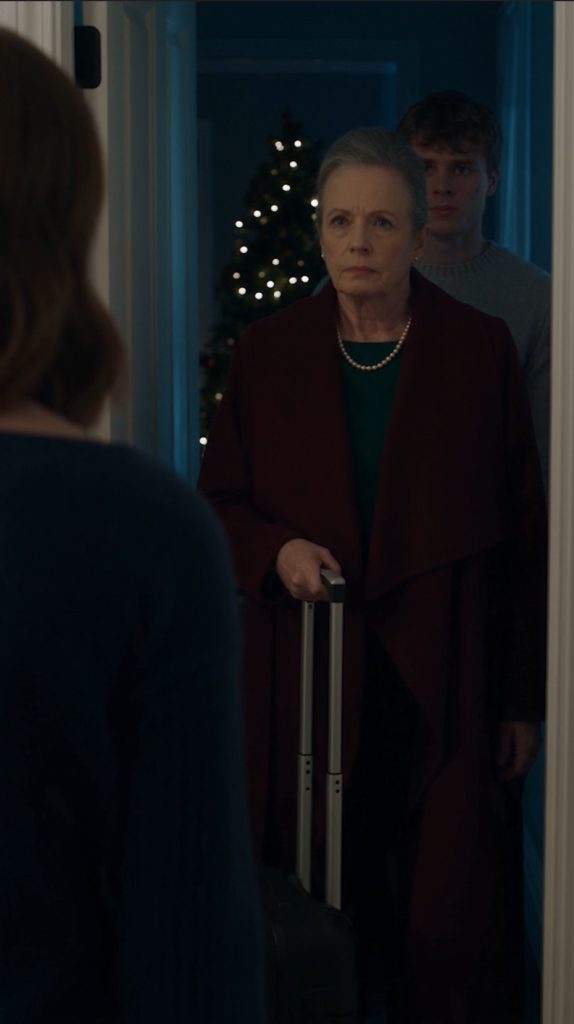
Then I saw my forty-six-year-old son Matthew standing behind Jessica, pale and silent. What frightened me most was not that she called my house hers—it was that my only child did not immediately correct her.
Fourteen days earlier, I had left the same red-brick house filled with thirty-eight years of memories. George and I bought it when Matthew was eight, measured his height against the kitchen doorway, rebuilt the back deck together, and spent our last Christmas there before cancer took my husband. I expected to return to the crooked wooden star George had made for our first Christmas and the ridiculous ornaments we collected through decades of marriage. Instead, almost everything that made the house feel like ours had disappeared.
The red-and-green porch lights had been replaced by perfect white strands. My crowded Christmas tree was now silver and white, stripped of Matthew’s childhood paper angels, my mother’s glass bell, Louise’s knitted stocking, and George’s crooked handmade star. Jessica said she had packed my decorations in the garage because there had been “so much clutter.” Then I noticed George’s brown jacket was missing from the hallway hook where I had left it for four years.
Jessica had packed that too.
Probably in the garage.
The hallway was now filled with their coats, shoes, shopping bags, and boxes. Matthew’s winter jacket hung where George’s had been, and Jessica’s bright pink coat occupied the hook that still felt sacred to me. When I asked why their belongings were everywhere, Jessica looked at me as though I were slow.
“Because we moved.”
Their lease had ended the previous week. Instead of calling me, asking for help, or waiting until I came home, my son and his wife simply moved into my house.
“We were going to talk to you when you got back,” Matthew said.
Jessica was less careful.
“It makes no sense for us to keep paying rent when there’s a perfectly good house sitting here.”
“Sitting here?”
“You were gone.”
I had been away fourteen days caring for my sister, not fourteen years.
Then I went upstairs.
Jessica’s dresses filled half my closet. Her perfume bottles covered my dresser. Her jewelry box sat beside a framed photograph of George and me from our thirtieth anniversary, and piles of her clothing were spread across the blue quilt George had given me during his final Christmas.
“Why are your clothes in my room?”
Jessica frowned.
“Because this is our room now.”
I looked at Matthew.
“Did you tell her this house would eventually be yours?”
His face changed.
For years, I had assumed my only child would inherit most of what I owned someday. George and I had talked about it, and after his death I updated my estate documents with Matthew as a beneficiary. But inheritance was supposed to come after my life—not slowly consume it while I was still standing inside it.
Matthew finally answered.
“Someday.”
Jessica almost smiled.
“Exactly.”
I looked directly at her.
“This house becomes Matthew’s after I die.”
She shifted.
“Well, yes.”
“So until then?”
Silence.
Matthew finally said, “It’s yours.”
Legally.
That word told me everything.
I gave them forty-eight hours to remove every box, coat, dress, and piece of furniture they had brought into my home. Jessica laughed and asked whether I would really call the police on my own son three days before Christmas.
“No.”
Her smile returned.
Then I finished.
“I’m calling my attorney. I’m changing every security code connected to the house. And I’m reviewing my estate plan.”
Matthew’s expression changed more dramatically at those last four words than it had when I told him to leave.
Reviewing my estate plan.
That scared him.
Jessica told me I could sleep in the spare room until Christmas because there was “no point moving everything around for three days.” Something inside me became perfectly calm.
If Matthew had called and said they were struggling and needed three months under my roof, I probably would have agreed. He knew that.
“So why didn’t you ask me?”
Jessica immediately answered that I would have complicated things.
I ignored her.
Matthew finally whispered, “We didn’t know how you’d react.”
“So you decided I didn’t get to react at all.”
He looked away.
That hurt more than Jessica’s insults.
For four years after George died, I had slowly made myself smaller. I accepted canceled Sunday lunches, jokes about my “sentimental clutter,” holidays arranged around their convenience, and whatever attention my son had time to give. During George’s final weeks, he had held my hand and whispered one sentence I never forgot: “Ellie, don’t get smaller after I’m gone.”
I had promised.
Then I spent four years breaking that promise.
“You have forty-eight hours,” I repeated.
That night, nobody left.
At 2:14 in the morning, unable to sleep, I walked into George’s old study and unlocked the fireproof box beneath his desk. I spread the deed, mortgage discharge, insurance documents, my will, and the trust amendment across his desk beneath the yellow lamp.
The house was mine.
Matthew was only a future beneficiary.
Nothing on those papers gave him any right to move into my bedroom.
But staring at the documents, I remembered the fear on my son’s face when I mentioned my estate plan.
And one new question entered my mind.
If Matthew had already started living as though my house belonged to him someday, what else had he already done based on that assumption?
By sunrise, the house was no longer the only thing I was afraid of losing.
At 6:40, the garage door groaned open beneath the study window.
I froze with the deed still in my hand. Nobody in this house had a reason to be in the garage before dawn, except the woman who had packed my whole life into it.
By the time I got downstairs in my robe, the side door was swinging on its hinge and cold air was pouring in. Jessica’s car was gone from the driveway. Her tires had cut two dark lines through the frost.
The garage light buzzed on above rows of cardboard boxes, each labeled in Jessica’s tidy black marker. XMAS JUNK. OLD KITCHEN. DONATE. I found my mother’s glass bell wrapped in newspaper and Matthew’s paper angels crushed flat beneath a box of George’s tools.
George’s jacket wasn’t there.
But beside the DONATE boxes sat a plastic bin that didn’t belong to me. Its lid was half off, as if someone had been digging through it in a hurry and been interrupted.
Inside was a manila folder.
My hands understood before my mind did. They went cold, then clumsy. The first page was a quitclaim deed with my address and my full name, Eleanor Margaret Hayes, typed neatly above a signature line. The new owners were listed as Matthew Hayes and Jessica Hayes.
Beneath it was a durable power of attorney. Beneath that was a sheet of printer paper covered in my own signature, written over and over. The early ones wobbled. The last ones were nearly perfect.
A yellow sticky note clung to the back of the folder in Jessica’s handwriting.
Notary — Dec 23, 10 a.m. Tell her it’s holiday insurance paperwork. She won’t read it.
I sat down on an overturned paint can because my knees refused to hold me. Today was December 23rd.
Was this what Matthew had been afraid of?
I thought of my son at eight, standing against the kitchen doorway while George marked his height in pencil. Did the boy who once cried when we stepped on ants know about this? Had he watched his wife practice my name at my own kitchen table?
I didn’t know. Not knowing was the worst part.
I called Harold Brenner at 7:05. He had been George’s closest friend and our attorney for thirty years, and he answered on the second ring. When I read him the sticky note, there was a long silence on the line.
“Ellie,” he said finally, “don’t sign anything. Don’t let anyone near that folder. I’m on my way.”
Then I made a choice I had been avoiding for four years.
I didn’t warn Matthew. If my son was part of this, I needed to see his face when he learned that I knew.
Jessica came back at 8:30 carrying coffee and pastries, humming. She stopped humming when she saw me sitting in George’s old chair at the kitchen table with the folder open in front of me.
Matthew came down the stairs, rubbing his eyes. “Mom? Why are you—”
Then he saw the signatures.
I had given birth to that face. I knew every version of it. What crossed it now wasn’t guilt.
It was horror.
He picked up the practice sheet with two fingers, as if it might burn him. “What is this?”
“Ask your wife,” I said.
Jessica set the coffee down very slowly. “It’s not what it looks like.”
“It looks like my mother’s name,” Matthew said. “Over and over.”
“It was just in case.” Her words came faster now. “Matt, she’s seventy-two. She lives alone. She forgets things. If she fell, we’d have no authority, nothing. I was protecting us. Protecting her.”
“By tricking her into signing the house over?”
“It’s going to be yours anyway!”
The words rang off the kitchen tiles. Nobody moved.
Then Matthew said something so quietly I almost missed it. “The lease didn’t just end, did it?”
Jessica’s jaw tightened.
“The eviction notice,” he said. “You told me it was a mistake with the landlord.”
The doorbell rang at exactly ten o’clock.
A young woman stood on the porch holding a leather case. “Good morning. I’m the mobile notary, here for Eleanor Hayes? Jessica said there’d be some holiday paperwork.”
Behind her, Harold’s old Buick pulled into the driveway.
What happened next was not loud. It was worse than loud. Harold laid the folder open on my dining table, and the notary looked from the typed deed to the page of practice signatures. I watched the color leave her face. She packed up her stamp without a word and told Harold she would be filing a report.
Jessica tried everything: tears, anger, my supposed confusion. She even pointed toward the garage as proof that I couldn’t let go of anything, as if loving my husband were a diagnosis.
Harold simply said, “Mrs. Hayes, attempting to defraud an elderly homeowner is a felony in this state. The note is in your handwriting, and the appointment was made in your name. The police will be very interested.”
Then Matthew stepped between his wife and me.
He didn’t step toward her. He stood in front of me.
“Get your things,” he told her, his voice shaking. “Not ours. Yours.”
She stared at him as if she’d never met him before. Maybe she hadn’t.
By noon, Jessica’s pink coat was gone from the hook. By evening, a detective had taken the folder, and Harold had explained that the debts she’d been hiding were in her name alone. There would be charges. There would be no house, and no someday.
When her car finally disappeared down the street, the hallway went so quiet I could hear the refrigerator humming.
Matthew stood beside the empty hook with his hands hanging at his sides.
“I didn’t know,” he whispered. “I swear I didn’t know about the signatures. But I let her move us in. I let her box up Dad. I let her talk to you like—” His voice broke apart. “I let you get small, Mom.”
I went very still. “What did you say?”
He didn’t answer. He climbed the stairs to his childhood bedroom and came back with something folded over his arm.
It was George’s brown jacket.
“She put it in the donate pile,” he said. “I pulled it out the first night and hid it in my old closet. I couldn’t let strangers have it.”
He reached into the inside pocket and pulled out a square of paper, gone soft from being unfolded too many times.
“I found this in there the day after the funeral.”
The handwriting was George’s, uneven from the medication, but unmistakably his.
Matty, your mother will try to disappear into taking care of everyone. Don’t let her get smaller. Make her laugh. Eat Sunday lunch with her. Love, Dad.
I pressed my hand to my mouth. “He told you too.”
“And I couldn’t do it.” Tears ran freely down my son’s face now, forty-six years old and crying like the boy at the kitchen doorway. “Every time I came over, I saw his chair and I couldn’t breathe. So I stopped coming. I thought if I stayed away, I wouldn’t have to see how badly I was failing him. When you said estate plan, I thought you were finally done with me. And I thought I deserved it.”
All those canceled lunches. For four years I had believed my son had simply stopped needing me.
He had been drowning in the same grief I was.
I took the jacket from him. It still smelled faintly of cedar and George’s aftershave. Then I pulled my son into my arms, and he folded down against my shoulder the way he used to as a boy, and for a long time neither of us said a word.
My sister Louise arrived on Christmas Eve, still pale from her illness, carrying a tin of shortbread and an opinion about everything. She took one look at the silver tree and said, “Absolutely not.” The three of us spent the afternoon in the garage, bringing out the paper angels, the glass bell, and the knitted stocking she had made forty years ago.
Matthew rehung the red-and-green lights along the porch. They blinked a little unevenly, exactly as they always had.
That night, he found George’s crooked wooden star at the bottom of the last box and held it out to me.
“You do it,” I said. “Your father would want you to.”
He climbed the step stool and set it on top of the tree. It leaned slightly to the left, just as it had for thirty-eight Christmases.
Before bed, I walked into the hallway and hung George’s brown jacket back on its hook.
Behind me, Matthew hung his winter coat on the hook beside it, next to his father’s this time instead of in its place.