A decorated police dog slammed a seven-year-old girl into the mud in front of a crowded park — and then refused to move, even when his own handler screamed at him to stop.
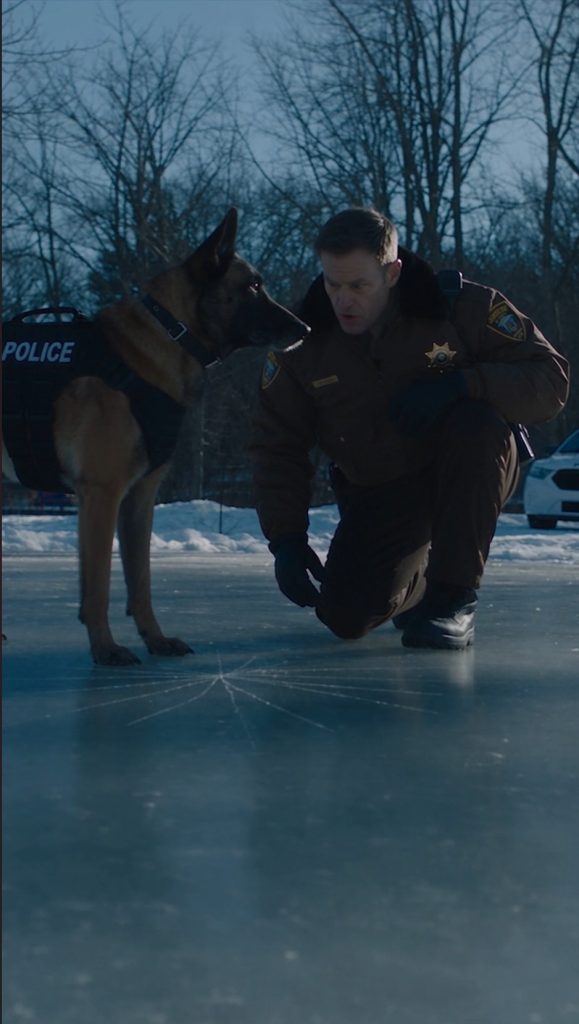
For three unbearable seconds, Officer Marcus Reed stood frozen, watching ninety pounds of Belgian Malinois pin a child to the wet ground. His voice cracked through the air — “Atlas! OFF!” — but the dog didn’t flinch. Didn’t blink. Didn’t obey a single command. And Atlas had never disobeyed. Not during gunfire. Not during building searches in pitch darkness. Not once in his entire career.
Until now.
The park had been full of laughter just moments before. A charity fun run. Music near the finish line. Kids racing bikes along the trail. Marcus and Atlas were there for nothing more than a friendly patrol. Then a girl on a pink bicycle pedaled past them, and Atlas locked onto her like she was a threat.
His ears snapped forward. His tail went rigid. A low growl rumbled from somewhere deep in his chest.
Marcus shortened the leash. “Leave it.”
Atlas pulled harder.
“LEAVE IT!”
The leash ripped free. Atlas launched across the grass at full speed. The girl — Sophie Lane, seven years old — turned just in time to see him coming. He hit her like a wall. She disappeared into the mud. Her scream split the park in half.
Her father reached them first, a baseball bat raised above his head. “I’LL KILL THAT DOG!”
Marcus threw himself between them. His hand found Atlas’s collar, but the dog snarled — not at Marcus, not at the father, not at Sophie. Atlas was staring at the ground beside the girl’s hand. Marcus followed his gaze. Wet grass. Mud. Dead leaves.
Then he heard it.
A soft, rhythmic ticking beneath the soil.
His blood turned cold. He dropped his voice to something barely above a whisper. “Everybody stop moving. Right now.”
He brushed the leaves aside with trembling fingers. A thin plastic lid sat buried flush with the earth. A wire disappeared beneath it. Then he saw the second wire — running directly under the patch of ground where Sophie had been about to step.
Atlas hadn’t attacked her.
He had thrown her clear of something buried in that park — something designed to go off.
Marcus keyed his radio. “Possible device. North lake path. Clear the area. Send bomb squad.” The words left his mouth steady, but his hands were shaking so badly he nearly dropped the handset.
Sophie’s father lowered the bat. His face went white. “My God.”
Then Atlas turned his head toward the tree line and growled again — deeper this time. A man in a dark rain jacket stood between two oak trees, watching. Marcus shouted, “Police! Stay where you are!” The man ran. Two officers gave chase.
Sophie tugged Marcus’s sleeve. Her voice was small and shaking. “That’s him. He was at my school on Friday.” She reached inside her coat and pulled out a folded photograph. “He told me not to show anyone until today.”
Marcus opened it.
The photo showed Atlas — not on patrol, not in the park — lying inside a kennel beside another police dog. On the back, someone had written in careful block letters: ONLY ONE OF THEM SURVIVED.
The date in the corner was five years old. Two years before Atlas had ever entered the department. And beneath the date, a name — written long before Marcus Reed had ever laid eyes on this dog.
His own name.
The radio crackled. The officers had lost the suspect. A car had been waiting. But he’d dropped something during the chase.
A police K9 badge — engraved with Atlas’s old name.
A name Marcus had never been told.
And when he finally traced who had owned that dog before him, he understood everything — why someone had buried a device in a public park, why they had chosen a seven-year-old girl, and why Atlas was never meant to survive that afternoon.
The badge sat in a sealed evidence bag on the precinct table under fluorescent light that buzzed like a dying insect. Marcus held it through the plastic. The engraved name read ROMAN. He turned it over three times, as though repetition might change what he was seeing.
“Roman,” he whispered.
Sergeant Diaz set a manila folder in front of him. She didn’t sit down. “Atlas was originally assigned to a K9 unit two counties south. Handler was a corporal named Evan Hartwell. Five years ago, the unit responded to a warehouse fire that turned out to be a staged distraction. An IED was planted inside. Two dogs entered. Only one came out.”
Marcus stared at the folder but didn’t open it. “Atlas.”
“Atlas. Except his name was Roman then. The other dog — a German Shepherd named Koda — was killed. Hartwell suffered burns across forty percent of his body. He was medically discharged. The department buried the report because the IED matched components that had gone missing from their own evidence locker.” Diaz paused. “Internal.”
Marcus looked up. “Someone inside built the bomb.”
“The investigation was never completed. Two witnesses recanted. The file was sealed. Hartwell disappeared from the system. Until today.” She slid a printout across the table. A driver’s license photo. The man from the tree line stared back at Marcus with calm, empty eyes.
Evan Hartwell.
Atlas’s first handler.
Marcus’s chair scraped the floor as he stood. His chest felt like someone had poured concrete into it. “He came back for the dog.”
“He came back for both of you.” Diaz tapped the evidence photo of the buried device in the park. “Bomb squad confirmed it was identical in construction to the warehouse IED five years ago. Same signature. Same wiring pattern. Same missing detonator component from the old evidence locker — one that was never recovered.”
Marcus pressed both palms flat against the table. The room was too bright. Too still. “He gave Sophie that photograph. He wanted Atlas to find it. He wanted me to know.”
“He wanted you to watch your dog die the same way Koda did,” Diaz said quietly. “Except Atlas didn’t follow the script.”
No. Atlas had rewritten it.
The dog had smelled the explosive compound from thirty yards away — the same compound that had killed the dog beside him in that kennel five years earlier. He had recognized it the way a person recognizes the voice of someone who once hurt them. Not with logic. With something deeper. Something wired into the oldest part of his brain, past training, past obedience, past every command Marcus had ever given him.
Atlas had disobeyed because obedience would have killed the girl.
The manhunt lasted eleven hours. Hartwell was found in a motel room fourteen miles east of the park, surrounded by diagrams, photographs, police scanner frequencies, and a wall covered in printed images of Marcus, Atlas, and — most chillingly — Sophie Lane walking to school on three separate mornings.
He had been watching for weeks.
When the tactical unit breached the door, Hartwell was sitting on the edge of the bed, hands on his knees, completely still. He didn’t resist. He didn’t speak. He looked at the officers with the flat patience of a man who had already decided that the outcome didn’t matter because the message had been delivered.
But the message hadn’t landed the way he planned.
Sophie’s father, Daniel Lane, stood outside the precinct the following morning. His eyes were swollen. He hadn’t slept. Marcus walked out through the glass doors and stopped when he saw him.
Neither man spoke for a long time.
Then Daniel’s voice broke. “I almost killed your dog.”
Marcus exhaled. “You were protecting your daughter.”
“He was protecting her first.” Daniel wiped his face with the back of his hand. “I raised that bat over my head, and the whole time — that dog was lying across my little girl to keep her alive.”
Marcus nodded slowly. He didn’t trust his voice.
Daniel stepped forward. “Can I see him?”
Marcus brought Atlas out through the side entrance. The Malinois walked calmly beside him, ears relaxed for the first time in two days. Daniel knelt on the concrete sidewalk. Atlas stopped in front of him and sat without being told. Daniel reached out slowly and placed his hand on the dog’s broad head. His fingers trembled.
“Thank you,” he whispered.
Atlas leaned into his palm and closed his eyes.
Sophie arrived with her mother minutes later. She ran across the parking lot, her pink sneakers slapping the wet asphalt, and dropped to her knees in front of Atlas. She didn’t say a word. She just wrapped both arms around his neck and pressed her face into his fur.
Atlas’s tail moved once. Twice. Then he lowered his head onto her small shoulder and exhaled — long and slow, as though he had been holding his breath since the moment he knocked her off that path.
Marcus watched from a few feet away. His throat ached.
Sergeant Diaz appeared beside him. She held a second folder — thinner this time. “There’s something else.”
Marcus looked at her.
“When Hartwell was discharged, the department reassigned Roman to a training facility upstate. He was supposed to be decommissioned. Put down.” Diaz opened the folder. “Someone intervened. Filed anonymous paperwork. Paid the transfer and rehabilitation fees out of pocket. Got the dog reclassified and placed into our unit under a new name.”
Marcus frowned. “Who?”
Diaz handed him a faded receipt. At the bottom, a signature.
Marcus read it twice. Then he stopped breathing.
The signature belonged to his father.
His father — a retired patrol sergeant who had died of a heart attack three years ago. A man who had never once mentioned a dog named Roman. A man who had simply shown up one evening, sat down at the kitchen table, and said, “There’s a new K9 coming into your unit next month. Request him.”
Marcus had laughed. “You don’t even like dogs.”
His father had smiled — that quiet, unreadable smile Marcus had never been able to decode. “Just trust me on this one.”
Marcus stood on the sidewalk now, holding the receipt, and understood for the first time what his father had done. He had saved Atlas not because he loved dogs, but because he had read the sealed report. He had known what happened in that warehouse. He had known that someday, somehow, Hartwell would come back. And he had made sure that when that day arrived, his son wouldn’t face it alone.
The receipt blurred in Marcus’s hands. He folded it carefully and pressed it against his chest.
Sophie looked up from Atlas’s fur. “Is he a hero?”
Marcus knelt beside her. He rested his hand on Atlas’s back, feeling the steady rise and fall of breath beneath warm fur.
“Yeah,” he said softly. “He always was. I just didn’t know the whole story yet.”
Atlas opened one eye, looked at Marcus, and let out a quiet sound — not a bark, not a whine. Something closer to a sigh. The kind of sound a dog makes when the person he was always meant to protect is finally close enough to keep safe.
The late afternoon sun broke through the clouds above the parking lot. Sophie laughed at something only she understood. Daniel placed his hand on Marcus’s shoulder and left it there.
And for the first time in five years, Atlas laid his head all the way down, stretched out across the warm concrete, and slept — deeply, peacefully, surrounded by every person who now knew exactly what he had carried, and loved him not in spite of it, but because of it.