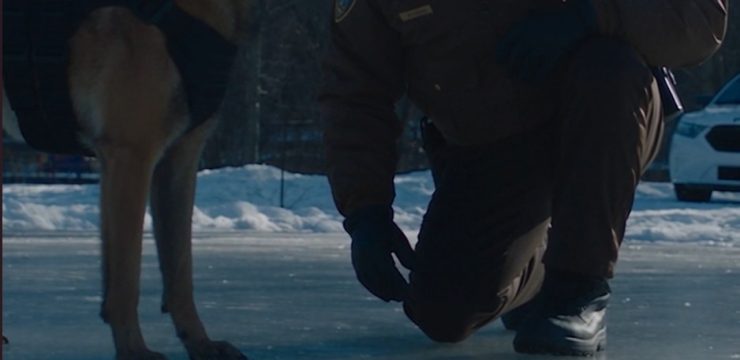
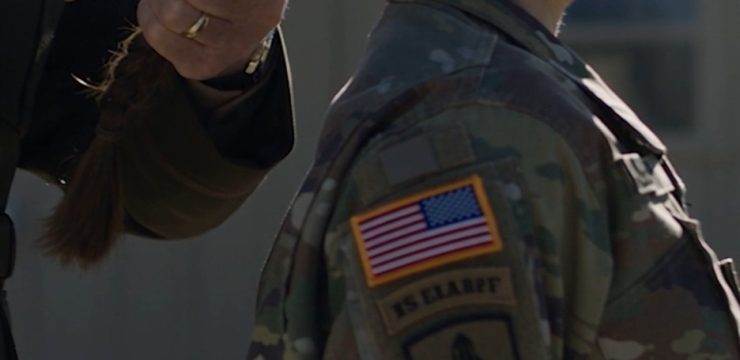
The moment he saw her, the boy stopped crying — and every officer in that room felt something shift in the air that none of them could explain.
But let me take you back to how it started.
The front desk was quiet. Half-finished coffee cups, the hum of a printer, the low murmur of phone calls going nowhere. Just another afternoon at a small-town police station where nothing much ever happened.
Then the door swung open.
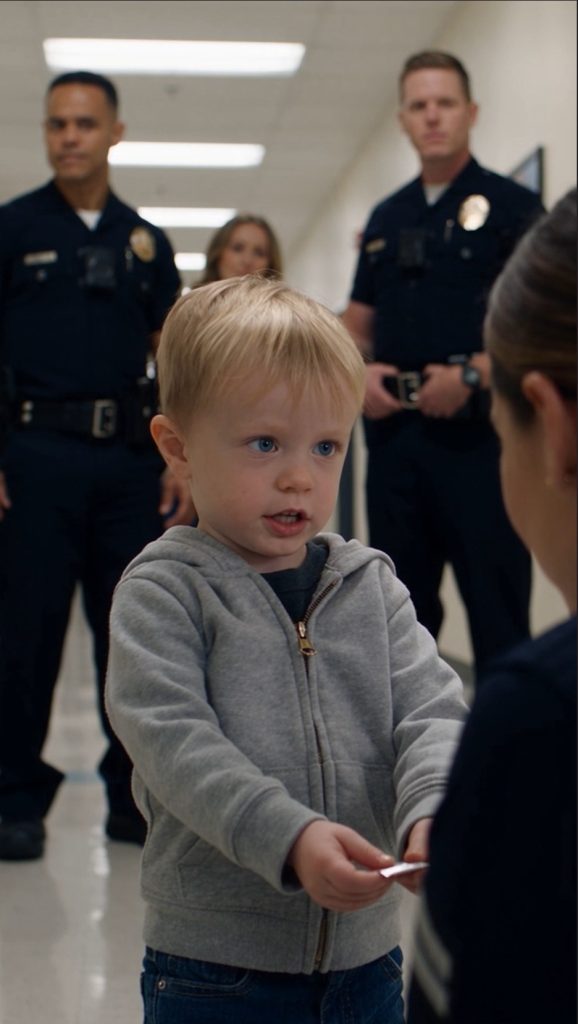
A young couple stepped inside — the father’s jaw tight, the mother’s face drawn with exhaustion. Between them, gripping his mother’s hand with both of his, was a small boy. Three years old, maybe less.
His eyes were swollen. His cheeks flushed and raw from tears that hadn’t stopped for hours. His tiny chest still hitched with the kind of breathing that comes after a child has cried so long his body can barely keep up.
The father approached the front desk. He hesitated. Rubbed the back of his neck like a man about to say something he knew would sound ridiculous.
“I know this is going to seem strange,” he said quietly. “But our son — he won’t stop. He’s been like this since this morning. He keeps saying the same thing over and over.”
The desk officer leaned forward slightly.
“What’s he saying?”
The father exhaled.
“He says he needs to see a female police officer. That’s it. That’s all he’ll say. He won’t eat. He won’t sleep. He just cries and begs us to bring him here.”
The officer blinked. Looked down at the boy. Looked back up at the father.
“Has he ever been to a police station before?”
“Never.”
“Does he know anyone who works here?”
“No one.”
A ripple of curiosity moved through the station. Officers drifted closer, one by one, pretending to refill their mugs or check a file. But they were all watching the boy.
One officer crouched down and tried to smile at him. The boy buried his face into his mother’s leg and sobbed harder. Another officer whispered something about a cartoon — maybe the kid saw a character on TV.
But the mother shook her head slowly.
“This isn’t pretend,” she said, her voice barely steady. “He’s terrified. I’ve never seen him like this. Something is wrong — I just don’t know what.”
The station had only one female officer on duty that day. A young lieutenant in her late twenties, buried in paperwork at a desk near the back. She hadn’t heard the commotion.
Someone knocked on her door.
“Lieutenant — there’s a child out front asking for you.”
She looked up, confused.
“For me?”
“Not by name. He just keeps asking for a woman in uniform. You’re the only one here.”
She stood slowly. Straightened her jacket. Walked toward the front lobby with the kind of cautious curiosity you carry when something doesn’t make sense yet, but your instincts are already pulling you forward.
The boy was still pressed into his mother’s side, face hidden, shoulders trembling.
Then he heard the footsteps.
He turned.
His red, swollen eyes locked onto the lieutenant — and something inside him broke open. His entire body went still. The crying stopped. Not gradually. Not like he was calming down.
It stopped like a switch had been flipped.
His lips parted. His small hands released his mother’s leg. And then — slowly, as if pulled by something no one else in that room could see — he began walking toward the officer.
Every conversation in the station died.
The mother’s hand flew to her mouth. The father took a half-step forward, then froze. The desk officer set down his pen without realizing he’d done it.
The boy stopped directly in front of the lieutenant. Looked up at her with an expression far too heavy for a face that small.
And then he spoke — just one sentence, so quiet that only she could hear it.
The color drained from her face.
She dropped to one knee. Her hands were shaking. She looked into the boy’s eyes for a long, breathless moment — and then she pulled him gently into her arms.
The boy buried his face into her shoulder. His small fingers clutched the fabric of her uniform. And for the first time in hours, his breathing slowed. His body softened. He wasn’t trembling anymore.
The lieutenant’s eyes glistened. She held him tighter, one hand cradling the back of his head, and whispered something against his hair that no one else could hear.
The mother stepped forward, tears streaming.
“What did he say to you? Please — what did my son say?”
The lieutenant didn’t answer right away. She stayed there on one knee, holding the boy like she was afraid the world would break him if she let go. Then she looked up at the mother — and the expression on her face made everyone in that room stop breathing.
“He said…” Her voice cracked. She swallowed hard. Tried again. “He said, ‘Please help. The man next door hurts me when Mommy and Daddy go to work.'”
The station went silent.
Not the polite kind of silence. Not the awkward kind. The kind that presses against your chest and makes time feel like it has stopped moving entirely.
The mother’s knees buckled. The father caught her just before she hit the floor. His face had gone white — completely white — like something inside him had just shattered into a thousand pieces he would spend the rest of his life trying to put back together.
“No,” the mother whispered. “No, no, no —”
The lieutenant stood, still holding the boy. Her jaw was set now. Her eyes had changed. The softness was still there underneath, but something harder had risen to the surface — the look of a woman who had just made a decision she would not back down from.
She turned to the desk officer.
“Get me a child protective services caseworker. Now. And pull everything we have on the family’s residential address — neighbors, records, complaints, anything.”
The officer was already reaching for the phone.
She turned back to the parents. Her voice was steady, but her hands were still trembling against the boy’s back.
“I need you to tell me exactly who watches your son when you’re at work.”
The father’s mouth opened. Closed. Opened again.
“Our neighbor,” he said, his voice hollow. “Mr. Garrett. He offered months ago. He said he loved kids. He was retired. It seemed —” His voice broke. “It seemed safe.”
The lieutenant nodded once. Slowly.
“It wasn’t.”
Within an hour, the station had transformed. Two detectives were dispatched to the neighbor’s residence. A social worker arrived and sat with the boy in a quiet room, speaking to him gently with crayons and stuffed animals while the lieutenant watched through a one-way window, arms crossed, jaw tight.
The boy drew pictures. Simple ones — the kind any child would draw. A house. A sun. A stick figure standing in a doorway with hands that were too large for its body.
The social worker’s face tightened when she saw it. She glanced at the lieutenant through the glass. Neither of them spoke. Neither of them needed to.
By evening, Mr. Garrett had been brought into the station in handcuffs. He was a small man, quiet, gray-haired — the kind of man a neighbor would wave to without thinking twice. He said nothing as they walked him through the lobby. His eyes stayed on the floor.
But the mother saw him.
She was sitting on a bench near the entrance, clutching a cup of water she hadn’t touched, when the officers led him past. She looked up — and the sound that came from her wasn’t a scream. It was something lower. Rawer. The kind of sound a person makes when the thing they feared most in the world is suddenly standing three feet in front of them.
The father had to hold her back.
The lieutenant stepped between them — not to protect Garrett, but to protect the mother from doing something that would follow her for the rest of her life.
“He will answer for this,” the lieutenant said firmly, looking the mother directly in the eyes. “I promise you. Not today — but in a courtroom. In front of everyone. And he will never touch your son again.”
The mother crumbled. She pressed her forehead against the lieutenant’s shoulder and sobbed — not the panicked sobs from before, but the slow, heaving kind that come when a person finally lets themselves feel the full weight of something they’ve been carrying alone.
The lieutenant held her. Steady. Still.
Behind the closed door of the interview room, the boy had fallen asleep on a small couch, a stuffed bear tucked under his arm. The social worker sat beside him, one hand resting near his, watching his chest rise and fall in the kind of deep, peaceful rhythm that only comes when a child finally feels safe again.
Weeks passed.
The investigation moved quickly. The evidence was overwhelming. Garrett had no prior record — which meant he had simply never been caught. But forensics found what they needed in his home. Files. Objects. Things that made seasoned detectives leave the room and stand in the hallway with their hands over their mouths.
He was charged on fourteen counts. He never made bail.
The trial was brief. The boy never had to testify — the physical evidence and expert testimony were more than enough. Garrett was sentenced to twenty-three years without the possibility of parole. When the verdict was read, he stared straight ahead, expressionless. But the mother — sitting in the second row with her husband’s hand in hers — finally exhaled for the first time in months.
Outside the courtroom, the lieutenant was waiting.
She hadn’t been required to attend. She came anyway.
The mother walked toward her slowly. No words at first. Just eye contact — the kind that carries everything two people have been through together without needing a single syllable.
Then the mother spoke.
“He asked for you,” she said softly. “Out of everyone in the world — he asked for you. I will never understand how he knew. But I will never stop being grateful that he did.”
The lieutenant smiled — a small, quiet smile that trembled just slightly at the edges.
“He didn’t need me,” she said. “He needed someone who would listen. I just happened to be the one who knelt down.”
The mother shook her head.
“No. It was you. It was always supposed to be you.”
They stood there for a moment, two women connected by something neither of them would ever be able to fully explain — and then the mother reached out and pulled the lieutenant into a hug so tight it made every person walking past the courtroom steps slow down without knowing why.
Months later, on a warm Saturday afternoon, the lieutenant — now promoted to captain — received a handmade card in her station mailbox. The envelope was addressed in crayon. Inside was a drawing: a small stick figure holding hands with a taller one in a blue uniform. Above them, in wobbly letters a child had clearly spent a long time forming, were three words:
“Thank you, hero.”
She pinned it above her desk.
It stayed there for the rest of her career — through promotions, transfers, and the hundreds of cases that followed. Colleagues would ask about it sometimes. She never explained the full story. She would just glance up at the drawing, touch the edge of the paper lightly, and say the same thing every time.
“A little boy reminded me why I do this.”
And on the other side of town, in a small house with new locks on every door and a nightlight glowing softly in a child’s bedroom, a boy slept soundly — deeply, peacefully — with a stuffed bear tucked under one arm and the quiet certainty, felt somewhere far beneath the surface of his dreams, that the world had at least one person in it who had listened when it mattered most.