The cork was already out of the bottle — the one bottle in the world I would have never opened. The Cabernet my husband bought for our fortieth anniversary, the anniversary we never reached because cancer stole him three months before the date. For four years, that sealed bottle was the last evening we never got to share. And now a woman I barely knew was drinking it in my favorite chair.
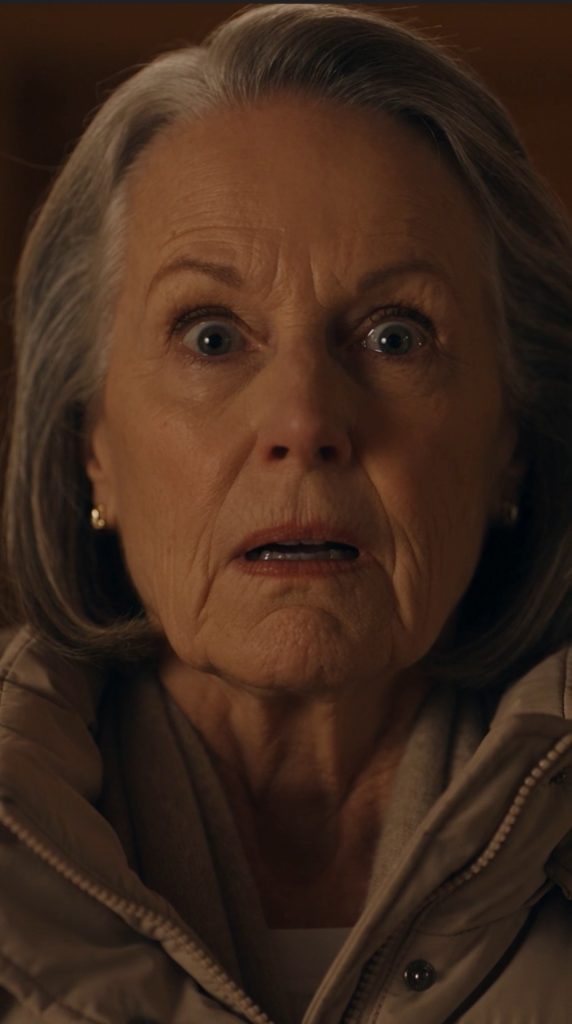
I hadn’t planned to be at the cabin that week. My Christmas trip had fallen through only two days earlier, so I drove up to the mountains alone, expecting silence and cold air and maybe a few tears by the fireplace. What I found instead were six unfamiliar cars in my driveway and a Christmas tree glowing through the front window — a tree I had never put up.
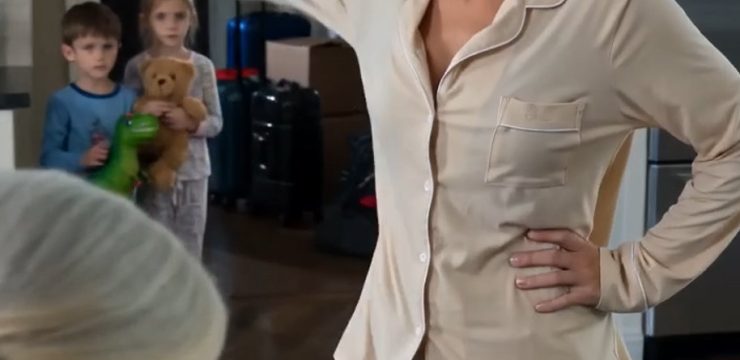
I unlocked my own front door and stepped inside. The warmth hit me first, then the noise — laughter, a television, the clinking of glasses. People I barely recognized were spread across every room. My mother’s china was laid across the dining table. Stockings hung from my mantel. Five suitcases were lined up beside the stairs like this was a hotel lobby.
Then Brenda Collins, my daughter-in-law’s mother, looked up from my blue chair and said the words that made my blood go cold. “Diane? What are you doing here?”
She wasn’t embarrassed. She was annoyed.
I asked how they got inside. Brenda said my daughter-in-law Sarah had given them the security code — a code I had only ever trusted to my son Jason and the property manager. My hands went still around the key in my fingers. This wasn’t confusion. This was coordinated.
I asked if Sarah had gotten my permission. Brenda waved the question away like smoke. “Family is family.” Then she told me they were staying through New Year’s and that I should cancel the property manager I’d scheduled to prepare the cabin for rental listings.
When I told her this was my house, she laughed.
But it wasn’t the trespassing that broke something inside me. It was the bottle. I saw it in her hand mid-sentence — the label, the year, the vineyard Robert had chosen so carefully. My throat closed. I told her to put it down, and something in my voice shut the entire room silent.
She set it beside the chair. But some things can’t be returned to the way you left them.
I carried the bottle into the kitchen and pressed the cork back in with shaking hands. Brenda followed me. She didn’t apologize. She said she understood I was “surprised” but this was supposed to be a family Christmas.
I asked whose family she meant. Her face hardened.
Then she said the thing I will never forget — the sentence that turned grief into something sharper. She tilted her glass, smiled, and said: “Sarah told us this place is basically going to be hers and Jason’s someday anyway. We’re just getting a little head start on the inheritance.”
She said it while I was standing alive in front of her.
Twenty minutes later, my property manager Michael arrived with the ownership file and calmly explained what Brenda apparently needed a professional to hear. Sarah had no ownership. No lease. No legal authority. No right to let anyone through my door. One by one, coats came off hooks. Suitcases rolled toward the door. The confidence drained from the room like air from a tire.
On her way out, Brenda turned and said, “You’re going to destroy your relationship with your son over a cabin?” I held the door open and said, “If my relationship with Jason depends on me surrendering my home, we have a much bigger problem than a cabin.”
Their cars disappeared down the mountain road. Michael helped me put things back. The counters were sticky. The furniture was marked. The house felt wrong in a way I couldn’t name.
Then I saw it — one gift still sitting beneath the tree. Large, flat, wrapped in silver paper, addressed to Sarah and Jason. And beneath their names, four words that made Michael stop beside me:
FOR YOUR FUTURE MOUNTAIN HOME.
I photographed it. Called Jason. Told him everything. When I read him Brenda’s inheritance line, his voice changed. When I sent the photo of the silver package, he went completely quiet.
Then he said: “Mom, don’t open it. I want Sarah there when we do.”
He promised to come the next morning. Michael said he’d return too — something in the property file he needed to check. That night, alone with the new security code set and Robert’s opened wine beside me, I sat staring at that silver package in the glow of a tree someone else had decorated in my home.
What happened when Jason and Sarah walked through that door the next morning changed everything 👇
The first thing I heard was tires on gravel. Then two car doors — not one. I set my coffee down and stood at the window. Jason climbed out of the driver’s side looking like he hadn’t slept. Sarah stepped out slowly from the passenger side, arms folded across her chest, her eyes already scanning the cabin as though she were measuring it.
Michael’s truck pulled in behind them three minutes later. He nodded at me through the windshield, and I saw the manila folder on his passenger seat.
Jason came through the door first. He didn’t say good morning. He walked straight to me, put both hands on my shoulders, and looked at my face the way he used to when he was twelve and afraid he’d done something wrong. “Are you okay?” he asked. I touched his cheek and said, “Sit down.”
Sarah stood near the entrance without removing her coat. Her eyes found the silver package beneath the tree immediately, and something passed across her face — not guilt, exactly. Recognition. The look of someone who knows exactly what’s inside a box before it’s opened.
I asked her to sit. She didn’t.
Michael came in quietly, set the manila folder on the kitchen counter, and leaned against the wall. He understood this was a family conversation, but he also understood that his presence kept it honest.
“Sarah,” I said. “Did you give your mother my security code?”
She looked at Jason instead of me. Jason didn’t move. The silence forced her back to my eyes.
“Yes,” she said.
“Did you tell her I’d be away for Christmas?”
“I mentioned it.”
“Did you tell her this cabin would be hers and Jason’s someday?”
Sarah’s jaw tightened. “That’s not exactly what I said.”
“Then tell me exactly what you said.”
She didn’t answer. Jason turned to her. “Sarah.”
Her voice came out flat and rehearsed. “I told my mom that this place would eventually come to us, and that it didn’t make sense for it to sit empty over the holidays when family could enjoy it. I didn’t think it was a big deal.”
Jason stared at her. “You gave away the code to my mother’s house. You moved your family in without asking her. And you told them it was theirs.”
“I said eventually.”
“Mom is standing right here.”
That sentence landed like a hand on a table. Sarah’s composure cracked for exactly half a second before she rebuilt it.
I pointed at the silver package. “Open it.”
Sarah hesitated. Jason walked to the tree, knelt down, and tore the silver paper in one clean pull. Inside was a framed architectural sketch — a renovation blueprint for this cabin. New kitchen. Expanded deck. A master suite where Robert’s study currently was. Across the bottom, in professional lettering, it read: COLLINS-WHITFIELD MOUNTAIN RETREAT — DESIGNED FOR THE NEXT GENERATION.
Jason held the frame without speaking. His fingers whitened around the edges.
“Your parents commissioned this?” he asked Sarah.
She swallowed. “It was supposed to be a surprise. For both of us.”
“A surprise,” I said quietly. “Renovation plans for a house you don’t own, designed to erase the room where your father-in-law wrote every letter he ever sent to Jason.”
The room went so still I could hear the clock in the kitchen.
Michael stepped forward. “There’s something else.” He opened the manila folder and laid a single sheet of paper on the counter. “When I was reviewing the property file last night, I found an inquiry submitted to the county assessor’s office two months ago. Someone requested a property valuation and asked about the process for adding names to an existing deed.”
Jason looked at the document. Then he looked at Sarah.
“The inquiry was submitted by Lawrence Collins,” Michael said. Larry. Brenda’s husband.
Sarah’s face drained of color. “I didn’t know about that.”
“Your father asked the county how to put his name on my mother’s property,” Jason said, his voice barely above a whisper. “And you didn’t know.”
“Jason, I swear — ”
“Stop.” He set the frame face-down on the floor. “Just stop.”
He walked to the window and pressed both palms against the glass. I watched my son’s reflection in the cold morning light, and I saw something I had seen only once before — the same expression Robert wore the day he decided to stop a business partnership with his best friend. Not anger. Clarity.
Jason turned around. “Mom, I owe you an apology. Not for what Sarah did — for what I allowed. I gave her the code because she asked, and I didn’t ask why. I assumed the best because it was easier. That’s on me.”
I nodded. My throat was too tight to speak.
He turned to Sarah. “We’re going to marriage counseling. That’s not a request. And you’re going to call your mother right now and tell her three things: this property belongs to my mother, the renovation plans are canceled, and if your father contacts the county about this deed again, we will involve an attorney.”
Sarah’s eyes filled with tears. “You’re choosing her over me.”
“I’m choosing honesty over whatever this has been.”
She stood there for a long time. Then she pulled out her phone, stepped onto the porch, and closed the door behind her. Through the glass, I watched her dial. I watched her mouth move. I watched her wipe her eyes once, hard, with the back of her hand.
Michael gathered his folder and shook my hand. “You know where to find me, Diane,” he said. At the door, he paused. “Robert would have handled it exactly the way you did.” Then he was gone.
Jason and I sat together at the kitchen table without speaking. The cabin was quiet again — truly quiet — for the first time since I’d arrived. I poured him coffee in one of Robert’s old mugs, and he held it with both hands the way he had since he was a teenager.
“Dad’s study,” he said after a while. “They were going to tear out Dad’s study.”
“Yes.”
He set the mug down. “I’m sorry about the wine, Mom.”
I looked at the bottle on the counter — still open, still half-full, still no longer what it had been. “Your father would have said wine is meant to be shared,” I told him. “He just would have preferred better company.”
Jason almost smiled. Almost.
Sarah came back inside twenty minutes later. Her face was blotched and raw, and she stood in the doorway the same way I had stood in it the night before — like someone entering a house that no longer feels like it belongs to them.
“My mother wants to apologize,” she said.
“I don’t need her apology,” I said. “I need her to understand that this home is not a future asset. It’s where Robert and I built thirty years of memories, and it will be treated that way as long as I’m alive.”
Sarah nodded slowly. Then she did something I didn’t expect. She walked to the mantel, took down the stockings her mother had hung, folded them carefully, and placed them by the door. She moved to the china cabinet and began putting my mother’s dishes back exactly where they belonged — each piece handled gently, each shelf checked twice.
Jason watched her. I watched him watching her. And I understood that whatever happened next in their marriage, this moment was the fork in the road. Not Brenda’s cruelty. Not the silver package. This — the quiet act of putting things back.
That evening, after Sarah and Jason left, I carried Robert’s wine to the fireplace and sat in my blue chair. The tree still glowed with someone else’s ornaments, but the house was mine again. I poured the last glass of the Cabernet and held it up to the light.
“Happy anniversary, Robert,” I said to the empty room.
The wine was extraordinary. Rich and deep and layered, the way a forty-year love story should taste. I wished he could have been there to try it. But as I set the empty glass down, I noticed something I had missed before — a small envelope tucked behind the bottle’s neck label, yellowed and brittle, sealed with a strip of tape.
I opened it with trembling fingers.
Inside was a note in Robert’s handwriting — the careful, slanted script I would recognize anywhere. It read:
Diane — If you’re reading this, the wine is finally open. I hid this note the day I bought the bottle, because I knew that whenever we drank it — whether on our anniversary or some ordinary Tuesday ten years from now — I wanted you to know: every single day with you was the celebration. You were never the ordinary part. You were always the wine. — R.
I pressed the note against my chest and closed my eyes. The fire crackled. Snow began to fall outside the window. And for the first time in four years, the cabin didn’t feel empty. It felt exactly the way Robert had always intended it to feel.
Like home.