My son and daughter-in-law moved into my quiet Charleston home without asking, expected me to babysit while they relaxed, and called me selfish when I refused, so I packed my bags, left for the coast, and stopped paying the bills they forgot were mine.
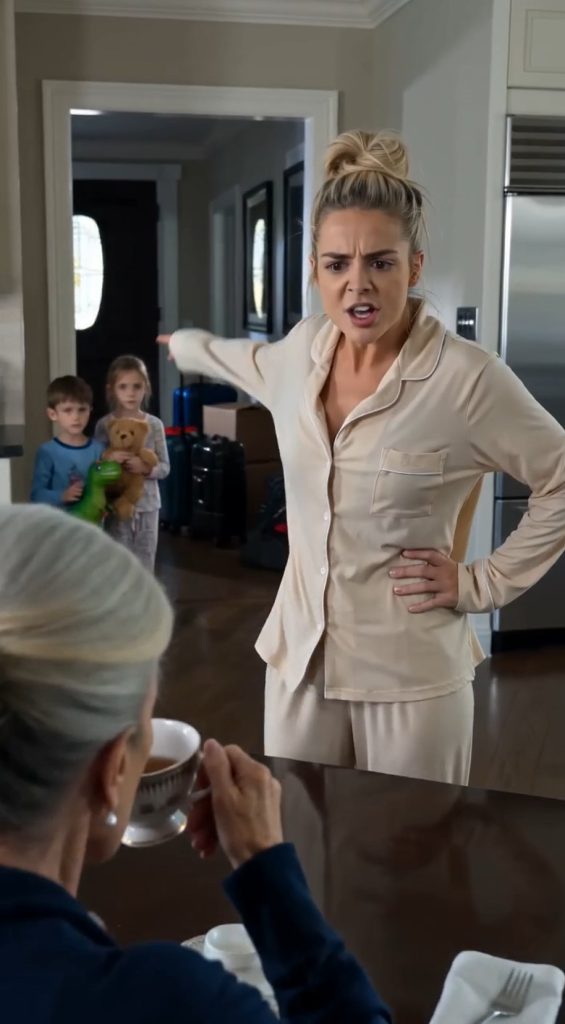
My son showed up at my door with his wife, his children, and a packed SUV without asking.
By morning, they expected breakfast, babysitting, clean dishes, and a free place to live.
When I said no, they called me selfish.
So I packed my bags, drove to the coast, opened my banking app, and by sunset, my son’s gas card was declined.
My home sits in a quiet, leafy suburb just outside Charleston, South Carolina, on a street where the live oaks lean over the road like old women sharing secrets. The houses are mostly brick, most of them built before people started calling every kitchen an “open concept.” Mine has a deep front porch, white columns, hydrangeas along the walk, and a brass door knocker I polish every month because I like things that last.
At sixty-eight, I have grown to cherish stillness.
Most mornings, my house smells like fresh coffee, lemon oil, old books, and whatever herbs I cut from the garden. I hear birds before I hear traffic. I can take my time folding towels. I can eat toast over the sink if I feel like it, or set a proper table if I do not. After four decades of work, marriage, motherhood, widowhood, and enough family emergencies to fill a filing cabinet, I had earned the right to live at my own pace.
That peace ended on a Tuesday evening.
I was in the living room reading when I heard tires scrape the curb outside. Not a polite pull into the driveway. Not the soft approach of a visitor. A hard, rushed stop. The kind that announces itself before the doorbell even rings.
I looked through the lace curtain.
My son Julian’s SUV was in front of my house, packed so full that bags were pressed against the back windows. Cardboard boxes were stacked in the cargo space. A laundry basket sat on top of a suitcase. Two backpacks hung from the passenger seat. My grandchildren were in the back, tired and restless, their faces glowing in the light from a tablet.
Julian stepped out first.
He looked worn down, like a man who had been driving too long with an argument sitting beside him.
Then Brooke got out.
My daughter-in-law was beautiful in the expensive, polished way women become when they decide appearance is currency. Blonde hair swept smooth. Designer trench coat. Sunglasses pushed into her hair even though the sun had already gone down. She did not look embarrassed. She did not look apologetic. She looked irritated that the driveway was not empty enough for her convenience.
My thumb hovered over the phone screen for a long moment before I pressed confirm, and somewhere three hundred miles behind me, I imagined the exact second my son’s card would fail at the pump.
It didn’t take long.
The first call came at 6:47 that evening, while I was still unpacking a single suitcase in a rented cottage that smelled like salt and cedar. I let it ring four times before I answered, just to feel what that silence was like — the silence of not rushing to fix something for once in my life.
“Mom.” Julian’s voice was tight, clipped, trying to sound calm and failing. “My card got declined. At a gas station. In front of the kids.”
I didn’t say anything right away. I looked out the window at the marsh grass bending in the evening wind, gold and green and endless, and I let the quiet stretch just long enough for him to hear it.
“I know,” I finally said.
“You know?”
“I closed the account I’d been putting your gas money into. And your phone plan. And half of Brooke’s car payment, which I don’t believe I ever agreed to in the first place.”
There was a long pause on the line. I could hear a child crying faintly in the background, and Brooke’s voice, sharp and muffled, telling someone to be quiet.
“You can’t just—” Julian started.
“I can,” I said. “I did.”
I heard him exhale, the sound of a man realizing the ground had shifted under him without warning. “Mom, we needed a place to stay. That’s it. We needed help.”
“You needed a place to stay,” I said. “So you found one. Mine. Without asking. And then you told me I had nothing better to do than raise your children for you.”
“That wasn’t—” He stopped himself. He knew it was true. I could hear it in the way his voice lost its footing.
“I love you, Julian. I have loved you since before you could hold your own head up. But I am not your safety net to be pulled tight whenever it’s convenient and then folded away when it isn’t. I am a person. I have a life. And for the first time in a very long time, I intend to live it.”
I hung up before he could answer. Not out of cruelty. Out of necessity. Some conversations need air between them to breathe into anything real.
For three days, I didn’t hear from him. I spent that time doing things I hadn’t allowed myself in years — walking the shoreline at dawn with a mug of coffee going cold in my hand, reading an entire novel in one sitting, cooking a meal for exactly one person and not apologizing for it to anyone. The cottage had a porch that faced the water, and in the evenings I sat there and watched the light change over the marsh, and I did not think of dishes that needed washing or grandchildren that needed minding. I thought of nothing at all, which felt like the most luxurious thing I had experienced in a decade.
Brooke was the one who finally called.
Her voice was different than I’d ever heard it — no polish, no performance. Just tired. “I need to talk to you,” she said. “Without Julian.”
I agreed to meet her, mostly out of curiosity, at a small diner off the coastal highway where the coffee was bad and the pie was better. She arrived without makeup, hair pulled back plain, wearing a cardigan that looked borrowed. She looked, for the first time since I’d known her, like an actual person instead of a photograph of one.
“I owe you an apology,” she said, before I’d even sat down fully. “Not the kind people give because they got caught. A real one.”
I waited. I had learned, over sixty-eight years, that the people who mean it don’t need you to fill the silence for them.
“My mother did this to me,” Brooke said, staring at the table. “Not the exact same thing. But close enough. She raised me and my sister basically alone, worked two jobs, and never once let either of us lift a finger to help her, because she thought that was love — protecting us from responsibility. And I grew up thinking that’s just what mothers do. They absorb everything so you don’t have to feel it.”
Her hands were wrapped around her coffee cup, knuckles pale.
“When we showed up at your house, I wasn’t trying to be cruel. I was doing what I’d always seen — assuming someone older would just… carry it. I didn’t see you. I saw a role. And when you said no, it broke something in me that I didn’t understand until the card got declined and Julian looked at me like I was the reason we were standing in a gas station parking lot with two crying kids and no plan.”
She looked up at me then, and her eyes were wet, and for the first time I saw not the woman who had swept into my home like she owned it, but a young mother who had been drowning long before she ever knocked on my door.
“I’m not asking you to fix this,” she said. “I don’t think that would be fair to you. I just needed you to know I finally understand what I did. To you. And honestly — to myself.”
I sat with that for a long moment, turning my fork over in my fingers, watching the steam rise off pie I hadn’t touched.
“Thank you for saying that,” I said. “It matters more than you know.”
“What do we do now?” she asked, and there was something almost childlike in the question, something that made my chest ache in a way I hadn’t expected.
“You find your own place,” I said gently. “Not because I don’t love you or the children. But because a marriage — a family — has to stand on its own legs before it can lean on anyone else’s. You and Julian have been leaning on me your whole relationship, in ways I let happen because I thought that was what a good mother does. I was wrong too.”
Brooke nodded slowly, wiping her eyes with the back of her hand. “And us? You and me?”
“We start over,” I said. “Slowly. Honestly. Without pretending the last two years didn’t happen.”
When I drove back to the cottage that evening, the sky had gone the color of a bruise healing — purple fading into gold along the horizon — and I felt something in my chest loosen that had been clenched tight for longer than I could remember.
Julian called again a week later, his voice steadier this time, no longer performing certainty he didn’t feel. He told me he and Brooke had found a small rental near his job, that he’d picked up extra shifts, that it was hard, that they were scared, that they were trying.
“I’m proud of you,” I told him, and I meant it in a way I hadn’t been able to mean anything toward him in a long time — not proud because he’d succeeded, but proud because he was finally trying with his own two hands instead of mine.
The twist came three weeks later, and it wasn’t the kind that announces itself with drama. It arrived quietly, the way real truths often do.
Brooke called to tell me she’d gone through old boxes while unpacking their new apartment and found a stack of letters — letters my late husband, Julian’s father, had written to Julian when he was small, letters I hadn’t known existed, tucked into a box of his old things that had somehow ended up in their moving pile from my attic. In one of them, dated the year before he died, my husband had written to a six-year-old Julian: Take care of your mother when I can’t. Not by doing things for her. By seeing her. Really seeing her, the way I do.
I sat on my porch reading a photograph of that letter Brooke had sent me, and I wept in a way I hadn’t allowed myself to in years — not from grief, but from the strange, aching beauty of understanding that my husband had known, even then, the exact lesson his son would need decades later. That the failure to see me hadn’t started with Julian. It had been a blind spot passed down, waiting for someone brave enough to finally notice it and choose differently.
Julian came to visit me alone the following weekend. He sat across from me at my kitchen table — the same table Brooke had once sighed over — and he cried, really cried, in a way I hadn’t seen since he was a boy.
“I’m sorry, Mom,” he said. “For all of it. For not seeing you.”
“You see me now,” I said, reaching across the table to hold his hand. “That’s what matters.”
He nodded, and for a long moment neither of us said anything, because some moments don’t need filling. The afternoon light came through the kitchen window and settled warm across the table between us, across our joined hands, across everything that had finally, quietly, come home.
That evening, after he left, I sat on my porch with a cup of tea going cold beside me, and I watched the live oaks sway the way they always had, keeping their old secrets, and I felt something I hadn’t felt in longer than I could say.
Peace. Whole and unhurried and entirely mine.