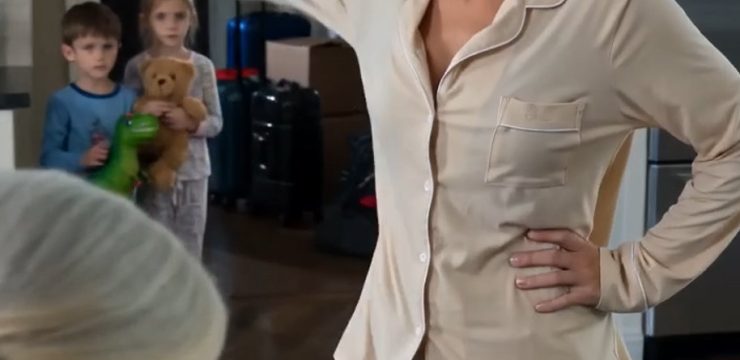
Sir, you’re sitting in the wrong place.”
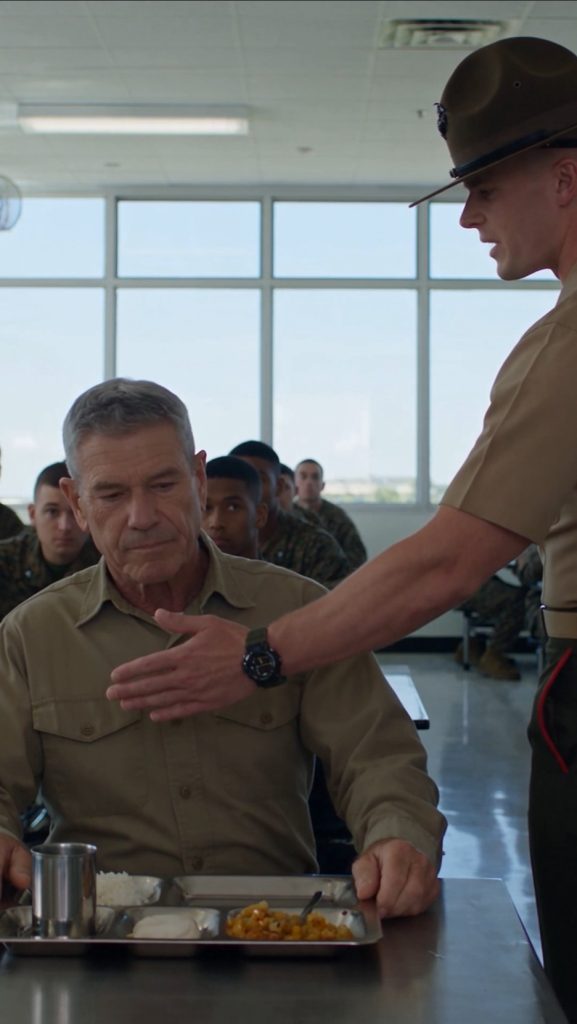
Arthur Bennett had barely lowered his lunch tray when Major Cole Barrett planted one hand on the chair beside him.
Arthur kept his fingers around the tray.
The plastic cup rattled against his plate.
Nearby conversations softened, though nobody openly stared yet.
Arthur looked at the empty chair.
Then he looked at Cole.
“Does somebody’s name appear on it?”
Cole’s jaw tightened.
He pointed toward the officers gathered around the long table beside the windows.
“This section is for people with accomplishments.”
Arthur studied him quietly.
“Is that right?”
A captain across the table stopped cutting his chicken.
Two lieutenants exchanged quick glances.
Cole noticed their attention and straightened.
His voice became louder.
Arthur’s faded jacket suddenly seemed to interest him.
A small metal badge rested above Arthur’s left pocket.
Its surface had been worn nearly smooth by decades.
Cole leaned closer.
“Don’t assume an antique pin turns somebody into a hero.”
A few heads turned openly now.
Arthur glanced down at the badge.
His thumb moved across its scratched edge.
“It is pretty old.”
One young officer covered a smile.
Cole heard it.
His own smile widened.
“Probably came from a thrift store.”
Two officers laughed.
The sound carried farther than either expected.
Arthur said nothing.
He stood beside his untouched lunch.
Cole hooked two fingers around the tray.
He dragged it across the table.
The plate scraped loudly against plastic.
Arthur caught his drink before it overturned.
Cole pointed toward a small table beside two gray trash containers.
“You can sit over there.”
The room became noticeably quieter.
Arthur looked toward the isolated table.
Then he returned his attention to Cole.
“Do you normally treat guests this way?”
Cole folded his arms.
“Only people who don’t understand where they belong.”
Arthur held his gaze another second.
Then he picked up the tray.
Nobody stopped him.
That silence hurt more than the laughter.
Arthur walked toward the trash containers.
Every step seemed louder than the last.
Behind him, Cole addressed the watching officers.
“Don’t start feeling sorry for him.”
A young soldier near the beverage station frowned.
Cole noticed him.
“Age doesn’t automatically equal service.”
Arthur heard every word.
He kept walking.
The soldier’s name was Private First Class Daniel Mercer.
He was twenty-two and stationed at Fort Liberty, North Carolina.
Daniel had been eating alone before the confrontation began.
Now his fork remained suspended above his mashed potatoes.
Something about Arthur bothered him.
Not the old jacket.
Not the badge.
It was Arthur’s reaction.
Most embarrassed people rushed away.
Some protested.
Others became angry.
Arthur did neither.
He moved with the controlled patience of someone accustomed to waiting under pressure.
Daniel had seen that posture before.
His grandfather carried himself similarly.
Grandpa Mercer had served twenty-six years in the Army.
He rarely discussed combat.
He always became quieter whenever someone else bragged.
Daniel lowered his fork.
Arthur reached the small table.
He carefully set down his tray.
The lid of the trash container swung behind him.
Someone dropped a bottle inside.
The hollow crash echoed.
Arthur pulled out the chair.
A second lieutenant at Cole’s table whispered something.
Cole laughed.
Arthur heard that too.
He sat.
For several seconds, nobody approached him.
Cafeteria noise cautiously returned.
Forks moved again.
Chairs shifted.
Conversations resumed in lower voices.
Arthur removed a paper napkin from the dispenser.
He unfolded it across his lap.
His movements remained unhurried.
His appetite had disappeared.
Still, he lifted his fork.
Across the room, Daniel kept watching.
Cole noticed.
“Mercer.”
Daniel straightened instinctively.
“Yes, sir?”
“You planning to conduct surveillance all afternoon?”
A few people laughed.
Daniel looked down.
“No, sir.”
“Then eat.”
“Yes, sir.”
Cole turned back toward his table.
Daniel stared at his plate.
His face burned.
He hated himself for answering so quickly.
Arthur finally took a bite.
The food was already cooling.
He chewed slowly.
His eyes moved toward the windows.
Outside, bright Carolina sunlight washed across the parking lot.
Soldiers crossed between brick buildings.
A shuttle stopped near headquarters.
Nothing outside suggested anything unusual.
Inside, Arthur could feel people avoiding his eyes.
Daniel’s chair scraped against the floor before he fully decided to stand.
The sound was small, but in that careful, half-restored quiet, it landed like a dropped weapon. Conversations stalled again. Somewhere near the windows, a fork clicked against a plate and stopped.
Daniel picked up his tray. His hands were not steady. The mashed potatoes shifted, and his cup sloshed, and he could feel Major Barrett’s eyes on the back of his neck like heat from an open oven.
He walked anyway.
Past the beverage station. Past a table of specialists who went very still. Past the invisible line that everyone in the room had silently agreed not to cross.
Arthur looked up when the shadow fell across his table. For a moment, his face showed nothing at all. Then something moved behind his eyes, quick and startled, as if he had heard a voice he had not heard in a very long time.
“Mind if I sit, sir?” Daniel asked.
Arthur’s gaze dropped to the name tape on Daniel’s uniform. It lingered there. His thumb found the edge of the old badge again.
“I’m not a sir, son,” he said quietly. “But the chair’s free. Nobody’s name is on it.”
Daniel sat.
The trash container lid swung shut behind them. The smell of cold coffee and bleach drifted past. Neither of them spoke, and somehow the silence at that small table felt warmer than anything happening at the long one by the windows.
It lasted less than a minute.
“Private Mercer.”
Cole Barrett stood over them, arms folded, his shadow cutting the table in half. The captain who had stopped cutting his chicken was watching now. So were the lieutenants. So was everyone.
“I gave you an instruction.”
“You told me to eat, sir.” Daniel’s voice cracked on the last word. He swallowed. “I’m eating.”
A few people inhaled sharply. Someone near the salad bar set down a plate with exaggerated care.
Cole’s face darkened by degrees. “You think this is funny? You think embarrassing an officer in front of the entire dining facility is a career move?”
“No, sir.”
“Then pick up your tray and get back where you belong.”
The words hung there. Daniel heard them twice: once aimed at him, once echoing from ten minutes earlier, aimed at the old man across from him.
His hands tightened around the edge of the table. He thought about his grandfather going quiet at barbecues while other men bragged. He thought about how fast he had said “yes, sir” the first time, and how much it had burned.
“With respect, sir,” Daniel said, “I think I’m right where I belong.”
Cole leaned down, close enough that Daniel could smell his aftershave. “Then you and your thrift-store hero can both explain yourselves to the MPs. I’m going to find out who signed this man onto my post.”
“That would be me, Major.”
The voice came from the entrance.
The dining hall doors were still swinging. A tall woman in uniform stood beneath the exit sign, two stars on her chest, a command sergeant major at her shoulder. Behind them, through the glass, the shuttle Arthur had arrived on sat idling near headquarters.
Every chair in the room scraped at once as soldiers came to their feet.
Major General Helen Whitaker did not look at Cole. She looked at the small table beside the trash containers, and her expression went from confusion to disbelief to something colder than either.
“Command Sergeant Major Bennett,” she said. “We’ve been looking for you for twenty minutes. The ceremony staff thought you’d gotten lost.”
Arthur rose slowly, folding his paper napkin and setting it beside his tray. “Wasn’t lost, ma’am. I was just shown where to sit.”
The general’s eyes finally moved to Cole.
The major’s arms had come unfolded. His hands hung at his sides, fingers twitching slightly, as if searching for something to hold.
“Major Barrett,” she said, “do you know who this is?”
Cole opened his mouth. Nothing came out.
“This is the man this afternoon’s ceremony is named after. Thirty-one years of service. Two combat tours in Vietnam. Former senior enlisted leader of the Eighty-Second Airborne Division. He trained the men who trained the men who trained you.” She paused. “That badge you’re looking at is a Combat Infantryman Badge. It isn’t sold in thrift stores.”
The silence was total. Even the kitchen had stopped.
“Ma’am, I didn’t—” Cole began. “There was a misunderstanding about the seating—”
“Was there?” She turned. “Captain Reyes. You were at that table.”
The captain who had stopped cutting his chicken stood very straight. His face was pale, and he did not look at Cole.
“No misunderstanding, ma’am,” he said. “The major removed the sergeant major’s tray and directed him to sit by the trash. I watched it happen.” He hesitated, then added, more quietly, “I didn’t stop it. I should have.”
One of the lieutenants lowered his eyes. The other, the one who had whispered, stared at the floor as if he could disappear into it.
General Whitaker nodded once, slowly. “Major, you’ll report to my office at fifteen hundred. You’re relieved of your duties pending a command investigation.” A beat. “And your name will be withdrawn from the battalion command list until it’s complete. I’d prepare for the outcome.”
Cole’s shoulders didn’t slump. They simply stopped holding anything up. He looked around the room for an ally, and every face he found turned away from him, the same way they had turned away from Arthur.
He walked out alone. Nobody stopped him.
The doors swung shut. For a long moment, no one moved.
Then Arthur sat back down.
He picked up his fork, looked at the cold food, and set it down again. His hand was trembling now, just slightly, in a way it had not trembled when the tray was dragged away.
“You all right, Sergeant Major?” Daniel whispered.
“I’ve been shot at by better men,” Arthur said. Then, softer, “It’s the laughing I never get used to.”
General Whitaker crouched beside the table. “I’m so sorry, Arthur. On behalf of this post.”
“Don’t apologize to me, ma’am.” Arthur nodded toward Daniel. “Thank him. He’s the only one who walked across the room.”
The general looked at Daniel for a long moment. “PFC Mercer, right?”
“Yes, ma’am.”
Arthur went very still.
“Mercer,” he repeated. “When the major called that name earlier, I thought my ears were playing tricks.” He leaned forward. “Son, was your grandfather Walter Mercer? Staff sergeant, First of the Fifth Cavalry, sixty-eight?”
Daniel’s breath caught. “He… yes. He passed three years ago.”
Arthur closed his eyes. When he opened them, they were wet.
Carefully, with fingers that had pinned hundreds of badges on hundreds of young soldiers, he unfastened the worn metal pin from his jacket and set it on the table between them.
“This isn’t mine,” he said. “It’s his. Mine was torn off when I went down in the A Shau Valley. Your grandfather carried me four hundred meters under fire. In the aid tent, he took his own badge off and pinned it on me so the medics would know I was infantry. Said I could give it back when I stopped needing it.” Arthur’s voice broke. “I wrote to your family for years. The letters came back. I never stopped wearing it.”
Daniel stared at the smooth, scratched metal. His grandfather had never talked about combat. Never once. And now Daniel understood why he always went quiet when other men bragged.
He had known what real courage cost.
Daniel’s hand hovered over the badge. He did not pick it up.
“Keep it,” he said, barely audible. “He’d want it on you.”
Arthur covered Daniel’s hand with his own. Neither of them spoke. Behind them, soldiers began to sit again, quietly, many of them looking at their plates in a way that had nothing to do with food.
That afternoon, in the auditorium named after him, Arthur Bennett stood before three hundred soldiers with his friend’s badge over his heart and asked PFC Daniel Mercer to stand beside him on the stage.
Two months later, on a chilly November evening in a small house outside Raleigh, Daniel’s grandmother opened her front door, looked at the old man on her porch, and pressed a hand over her mouth.
“Walter kept every one of your pictures,” she whispered. “He told me you’d come.”
Inside, the kitchen smelled of cornbread and turkey. The table was crowded and loud and warm. And beside Daniel’s chair, where the light from the window fell softest, sat a small handwritten card that read, simply, Arthur.
He touched it for a long time before he sat down.
This time, there was a chair with his name on it.