The Colonel Cut Off His Subordinate’s Long Hair In An Attempt To Punish Her For Disobedience, But What The Young Woman Did Afterward Left The Entire Company In Shock 😮
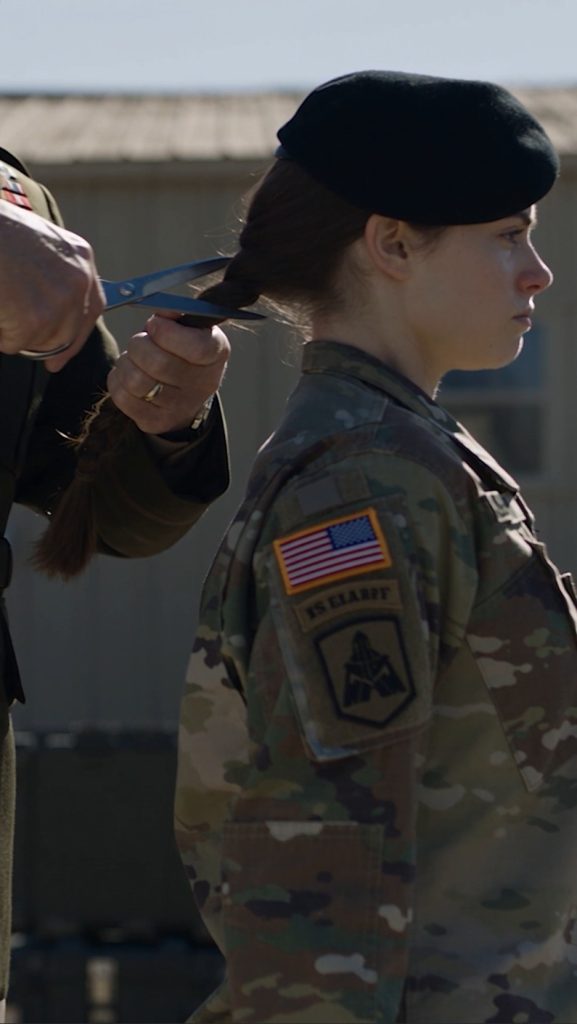
Early that morning, all the soldiers in the unit had gathered on the parade ground.
The ranks stood neatly under the blazing sun. No one spoke. Everyone understood that something unusual was about to happen.
In the center of the parade ground stood only two people.
The colonel and a young recruit named Anna.
The young woman had arrived at the unit only a few days earlier. She was one of the top graduates of the military academy, an excellent marksman, quick to complete every requirement, and never complained about difficulties.
But by the second day, a conflict had already broken out between her and the colonel.
During a training exercise, one of the soldiers suffered a serious injury. The young man fell after a failed jump and hit his back hard.
The colonel ordered the training to continue.
— He’ll get up on his own. He’s not going to fall apart, he said coldly.
But Anna stepped out of formation and ran to the injured soldier.
— He needs a doctor.
— Return to formation! the colonel ordered.
— He needs help first.
Dozens of soldiers heard those words.
To the colonel, it was a personal insult. No one dared to challenge him in front of his subordinates.
A few days later, he decided to make an example of her.
The colonel ordered the entire unit to assemble on the parade ground. When the soldiers had taken their places, he called Anna forward.
The young woman calmly stepped out of the ranks. Her long dark braid nearly reached her waist. Every soldier knew how much she cared about her hair.
The colonel pulled out a large pair of scissors. A nervous murmur spread through the ranks. Some soldiers already understood what was about to happen.
Anna stood perfectly still.
The colonel grabbed her braid and said loudly enough for everyone to hear:
— This will teach you not to argue with people who outrank you.
A second later, the scissors snapped shut.
The thick braid fell to the ground. Silence settled over the parade ground. The colonel watched the young woman closely.
He expected tears. He expected a breakdown. He expected pleas for forgiveness. But none of that happened.
Anna did not even move. Her face remained calm. She stared straight ahead as if nothing had happened.
For some reason, that calmness only made the colonel angrier.
He stepped forward.
— Do you think you’re special?
The young woman remained silent.
— You’re just a recruit.
No reaction.
— People like you break faster than anyone else.
Anna continued staring straight ahead.
— Without your pretty hair, you finally look like a real soldier instead of a spoiled little girl.
A wave of uneasy murmuring moved through the ranks. Many soldiers felt uncomfortable.
But the colonel had no intention of stopping.
— You think far too highly of yourself. Remember your place.
The colonel believed he had the right to humiliate an innocent person, but what the young woman did in response left the entire company in shock.
Anna slowly lowered her eyes to the severed braid lying at her boots.
For several seconds, she said nothing.
Then she bent down.
She picked up the braid with both hands, brushed a few strands of dust from it, and held it against her chest.
The colonel gave a short, humorless laugh.
“Finally,” he said. “Reality seems to have reached you.”
Anna looked up.
“No, sir.”
Her voice was quiet.
That quietness carried farther than a shout.
“Reality reached me several years ago.”
Something changed in the colonel’s expression.
Anna reached inside the pocket of her uniform and removed a small, weathered photograph. She held it between two fingers.
The soldiers nearest her could see the image.
A young man in uniform stood beside a teenage girl with the same long dark hair Anna had just lost.
Her brother.
Anna looked at the colonel.
“That braid belonged to him too.”
The colonel’s smile disappeared.
“He was the soldier you ordered to continue training.”
The parade ground seemed to shrink around them.
Anna swallowed once.
“He was injured that morning. You told everyone he would get up.”
No one moved.
“He didn’t.”
The colonel’s face hardened.
“That incident was investigated.”
“Was it?”
Anna reached into her other pocket and removed a folded document.
“The official report says he was evacuated after the exercise. It says his condition deteriorated later.”
She unfolded the paper.
“But the medical record says the ambulance was delayed because the exercise was ordered to continue.”
A soldier near the back lowered his head.
Another looked directly at the colonel.
Anna continued.
“I didn’t disobey you because I wanted to embarrass you. I disobeyed because I recognized the same mistake happening again.”
The colonel stepped toward her.
“Give me that document.”
Anna didn’t move.
“That’s an order.”
“No, sir.”
The answer was almost gentle.
“It isn’t yours anymore.”
A captain standing beside the formation suddenly stepped forward.
“Sir…”
The colonel turned sharply.
“What?”
The captain’s jaw tightened.
“I was there that morning.”
The colonel stared at him.
“I wrote the original medical statement.”
A murmur passed through the ranks.
“You signed it,” the captain said. “But you didn’t write what happened.”
The colonel’s eyes narrowed.
“You are accusing your commanding officer?”
“I am correcting the record.”
Another soldier stepped forward.
Then another.
One had kept the photograph from the ambulance log. Another had remembered the exact time the medic was called. A third had saved a copy of the training schedule.
Piece by piece, the truth emerged.
The colonel had not merely made one cruel decision.
He had ordered records altered to protect his command reputation.
Anna listened without interrupting.
When the final document was placed on the table, the colonel stared at the stack as though it belonged to someone else.
Then a vehicle entered the parade ground.
A senior military investigator stepped out.
The colonel’s shoulders stiffened.
The investigator walked toward him and held out his hand.
“Colonel.”
For the first time that morning, the colonel looked uncertain.
The investigator took the documents.
“You are relieved of command pending a formal investigation.”
Nobody celebrated.
There was no cheering.
No one wanted to turn justice into another spectacle.
The colonel looked around at the soldiers who had once stood rigidly at his command.
Not one stepped forward to defend him.
His authority had vanished without a single soldier needing to take it from him.
He looked at Anna last.
“You planned this.”
Anna shook her head.
“No.”
She looked down at the braid in her hands.
“You did.”
The colonel was escorted away.
The gates closed behind him.
For several seconds, nobody spoke.
Then Anna’s hands began to tremble.
It was the first sign that the calmness she had shown all morning had been held together by sheer will.
The captain who had spoken stepped toward her.
“I’m sorry.”
Anna looked at him.
“You didn’t cut it.”
“No.”
He glanced at the braid.
“But I watched.”
That confession hurt more than she expected.
She took a slow breath.
“So did all of us.”
The captain lowered his eyes.
“I should have spoken sooner.”
Anna studied his face.
“Then speak now.”
He nodded.
“I was afraid.”
Anna’s expression softened.
“So was I.”
It was the first time anyone had heard her admit it.
The captain looked surprised.
Anna gave a faint smile.
“Being afraid doesn’t make you weak. Staying silent when someone needs help does.”
The words settled over the formation.
One by one, the soldiers began speaking.
Not speeches.
Small truths.
A private who had been afraid to report unsafe equipment.
A sergeant who had been punished for questioning an order.
A medic who had been told to keep quiet about delayed treatment.
None of them could undo what had happened.
But for the first time, they were allowed to name it.
Weeks later, the unit received the official findings.
The colonel was permanently removed from command and faced formal disciplinary and legal proceedings related to the falsified records and treatment of personnel. The injured soldier from the training accident received further medical care, and his family was finally given the complete record of what had happened.
Anna was offered a transfer.
She refused.
The officer reviewing her request looked confused.
“You can leave this place.”
“I know.”
“Why stay?”
Anna looked through the window at the parade ground.
“Because leaving is not the only way to survive something.”
She stayed.
Not because she had forgotten.
Because she hadn’t.
The unit changed slowly.
Training rules were reviewed. Medical procedures were enforced. Soldiers were encouraged to report unsafe conditions without fear of retaliation.
And nobody ever again treated silence as proof of obedience.
One evening, Anna returned to the barracks after training and found a small box outside her room.
Inside was a black ribbon.
Beside it was a note.
No signature.
Just four words.
“For the hair you chose.”
Anna sat on the edge of her bed for a long time.
Then she smiled.
Months passed.
Her hair began growing back.
The first time the braid was long enough to tie, she stood in front of the mirror and ran her fingers through it.
She almost reached for the scissors.
Then she stopped.
A knock came at the door.
The captain stood outside.
“May I?”
She nodded.
He noticed the braid.
“You kept it.”
“I grew it back.”
He smiled.
“You look different.”
Anna touched the ribbon.
“No.”
She looked at herself in the mirror.
“I look like myself.”
He was quiet for a moment.
Then he handed her an envelope.
“Your academy sent this.”
Inside was an old photograph.
Anna stared at it.
It showed her standing beside her brother years before she had entered military school.
But there was something else.
On the back, in her brother’s handwriting, were six words.
“Never let anyone cut your courage.”
Her eyes filled.
She pressed the photograph to her chest.
The captain stepped closer but didn’t touch her.
Anna finally whispered, “He knew me better than anyone.”
“He still does,” the captain said.
She looked at him.
“How can you say that?”
“Because you kept doing exactly what he hoped you would.”
Anna laughed through her tears.
For the first time, the sound wasn’t forced.
It was light.
It was alive.
The next morning, she returned to the parade ground.
The sun was softer than it had been on that terrible morning.
The soldiers stood in formation, but something about them was different now.
They looked at one another.
They listened.
And when Anna walked past them, several soldiers smiled.
She stopped at the center of the field.
Her braid rested against her back.
Not as a symbol of defiance.
Not as something she needed to protect from anyone.
Simply as part of herself.
The captain approached with a small wooden case.
Inside was the pair of scissors that had been taken from the colonel.
Anna stared at them.
Then she closed the lid.
“Keep them,” she said.
He frowned.
“Why?”
“Because I don’t want to remember him every time I look in the mirror.”
She handed the case back.
“I’d rather remember what came after.”
The captain nodded.
That evening, Anna visited the memorial wall where the names of fallen and injured service members were recorded.
She placed the black ribbon beside her brother’s photograph.
Then she touched the stone with two fingers.
“I didn’t forget you.”
The wind moved gently through the trees.
She closed her eyes.
For years, she had believed that strength meant never allowing anyone to see her break.
Now she understood something different.
Strength could also mean letting someone stand beside you.
It could mean telling the truth.
It could mean admitting you were afraid.
And sometimes, it meant growing back the thing someone tried to take from you—not because you wanted to prove them wrong, but because it belonged to you.
Anna walked back toward the barracks as the evening lights came on one by one.
Behind her, the memorial remained quiet.
Ahead of her, warm windows glowed against the dark.
She paused at the doorway, touched the end of her braid, and smiled.
Then she stepped inside, where the voices of the soldiers she had once stood among rose around her like the sound of people finally learning how to become a family.
And for the first time in a very long while, she knew exactly where she belonged.